Showing posts with label kodaly. Show all posts

Friday, January 27, 2012

Solfeggio: Kodaly's 'Moveable" DO

A fun activity that I encourage my parents to do with their children is to place a few m&m's in a musical pattern on a blank music staff for their children to play on the their tone bells.
A great question came up about the activity. Something like, "When I put an m&m on the first line 'e' and tell her to start on 'c' on the bells, is the activity more about staff relationships or should I be telling her it's actually an e but we're starting on c?" This is where knowledge of the 'Moveable' DO System helps everything make more sense.

Parents often wonder why I'm telling the children that the first line is 'middle c' when it's actually 'e' when we're practicing sight reading from the staff. What I'm actually telling them is that the first note, wherever I may put it, is DO. Not 'c' or 'e' or any other letter. Since there's no clef on the staff to tell of where 'middle c' is, it can be anywhere!
Let's let Shelle explain further...


'Moveable' DO System
The Kodaly solfeg system (used by LPM) is called a 'Moveable' DO system where in any given key, the first note of the scale is DO. In other words, in the key of F major, 'F' is DO or in the key of A flat, 'A flat' is DO. Dick Grove, a notable musician and educator of the late 20th century, has said, "The best and most productive version of solfeg is [the] 'Moveable' DO'." (Grove)

The alternative form of solfeggio is a 'fixed DO' system, meaning that middle C is always DO, D is Re, and so on. But, to a child who has learned through solfeg the concept of 'Moveable DO' there are no restrictions, there is no loyalty to the note or key of C! This concept of a moveable DO is vital as a child learns to transpose and arrange music because they are not trapped by the idea of Middle C being DO, rather, they are aware of pitch relationships within any key or scale.


"Whether it is E or G is less important than whether it is mi or so. Each note has a character in the context of the scale. Think of the role of B or C, then think of the role of ti or do. Without knowing the key we are in, B or C could be anywhere, but ti and do have meaning according to their position in the Major scale." -Gregory R. Giese


So there you have it!! The reason for all the syllables and hand signs in every class! It's part of the awesome curriculum that provides the best musical foundation for building great musicians!
This concludes the 5 part series of "Solfeggio: The Language of Music" written by Let's Play Music creator and founder, Shelle Soelberg. Hope you enjoyed!

Thursday, January 26, 2012

Solfeggio: Kodaly Method cont'd

Patterning
Another method Kodaly promulgated was that of pattern imitation, or patterning. This is the planned sequence of certain melodic motives that are presented to the children first in songs, and imitation exercises. Through this presentation, the children would internalize these patterns, which would then open the door for them to be identified, labeled, and notated. In this way, Kodaly sought to produce children who not only could read music, but who felt it and understood it.

Inner Hearing and Tonal Center
Hand signs and patterning promote "inner hearing", a term that Kodaly created. Inner hearing is the ability to hear music in the mind without any music actually being present, and is the precursor to all musical skill. One of the fundamental skills is developing tonal orientation, or a feel for tonal center. Tonal center, is the 'pull' toward the tonic chord and the tonic pitch (DO). A child who has developed tonal orientation can hear a piece of music in whole or part, can accurately decipher where DO is and can sing it. When this skill is acquired, it is then possible to hear a piece, determine the pitch relationships, and then write down, transpose, or compose a harmony to these notes.


Good stuff, right?! With Let's Play Music classes, your child will be able to feel and understand music. He'll be able to write down music, transpose it, and compose harmony to it without seeing the notes first!
Come back tomorrow for the final section of the series, 'Moveable' DO system! It answers a common question I hear from parents during the first year of classes.

Wednesday, January 25, 2012

Solfeggio: The Kodaly Method

The Kodaly Method
Zoltan Kodaly (pronounced [KOH-die], Hungary, 1882-1967) was a revolutionist who changed the attitudes of teaching music to children. His addition of hand signs and use of 'patterning' are means for the goal of developing the music within the child.

Hand Signs
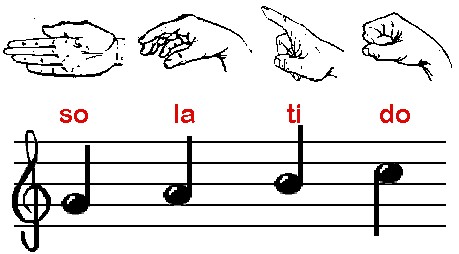
Kodaly went a step beyond solfeg syllables and added hand signs to each syllable which represent the function of each step of the major scale. In this way, full body involvement is utilized because the hands can 'feel' the major scale. Thus, while singing in solfeg, the child is producing the pitch with his voice, hearing it with his ear, and reinforcing that pitch relationship with his hands. Further, the hand signs were structured in such a way, that each one accurately links the pitch to its function within the scale like this:
When singing the solfeg syllables, the hands begin near the waist with DO and each consecutive sign is slightly higher than the previous one, with the octave DO being a height near your forehead. Hand signs must always communicate pitch height to be completely effective.

Tomorrow, the awesome method of Patterning, and how it develops Inner Hearing, and Tonal Center.

Wednesday, February 9, 2011

Parent Testimonial: solfeg patterns

I was excited to hear about one little cutie and how she discovered she could play the solfeg patterns on the piano! She was playing around on the piano and played some notes that sounded like her patterns from class! She got excited and said, "Look mom, I can play sol, la, ti, do on the piano!" It's just so great that these kids are excited about music!


Her ears are very sensitive to sounds at this age (4-5) and Let's Play Music takes advantage of that by doing lots of ear-training. Using Kodaly techniques and solfeg patterns is one of the ways we do this.  Briefly, Solfeg patterns help the ear to hear a tonal center. They also train us to audiate. Audiation means to hear music in our heads without seeing it written down first or hearing it first. This is necessary for singing in tune and singing in harmony with others.

Tuesday, June 15, 2010

Zoltan Kodaly


"The pure soul of the child must be considered sacred; what we implant there must stand every test, and if we plant anything bad, we poison his soul for life." 


(Selected Writings, p. 141)

I had a GREAT time at the Let's Play Music symposium on Saturday! We were treated with a presentation on one the past music education philosophers who is integrated throughout the Let's Play Music program. I am a Kodaly teacher! 


I was inspired by the presentation and am thrilled to be teaching his brilliant methods and theories.


I can't help but want to study him more when I read quotes like the one above.